China’s Compact Shelving market includes manufacturers serving warehouses, archives, offices, and retail operations. This guide introduces ten suppliers and the factors buyers can compare before requesting a quotation. A ranked list can be useful, but it is not a substitute for checking a supplier’s current product specifications and project experience.
For transparency, the following is an illustrative editorial line, not a verified quotation: fictional storage-planning expert Maya Chen says, “Good compact shelving saves space only when people can use it safely and smoothly.” That practical point matters. A dense installation may look impressive on a floor plan, yet awkward aisle access or poor labeling can slow everyday work.
The comparison will consider product range, customization, load information, drive options, installation support, and after-sales service. Buyers should also ask for drawings, clear capacity details, and references from comparable projects. Small details matter. For example, a library storing heavy archive boxes may need different shelf layouts from a clinic organizing frequently accessed files. Supplier strengths vary, and available evidence may not be equally detailed for every company. Treat the top ten as a starting point, not a final verdict; confirm that each shortlisted manufacturer can meet the site’s requirements.
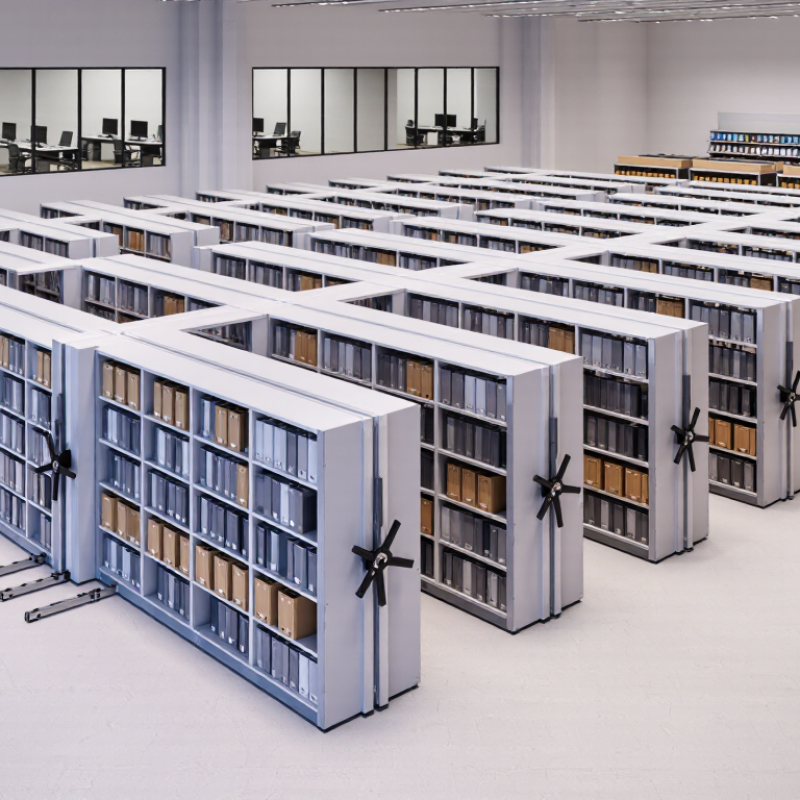
Compact shelving is a high-density storage system that moves shelving rows to create an access aisle only where needed. Fixed shelving keeps every aisle open; mobile systems reduce that wasted floor area. Common types include manually operated carriages, mechanically assisted units, and powered systems with safety controls. Space is the payoff.
The U.S. Census Bureau’s Quarterly Retail E-Commerce Sales report for 2024 estimated online retail sales at $1.19 trillion, up 8.1% from 2023. E-commerce represented 16.1% of total retail sales. This does not prove that online shopping alone drives compact-shelving demand, but it helps explain why some warehouses need denser, organized stock storage. Compact shelving also suits archives, libraries, medical-supply rooms, and parts departments, where staff handle many small items in limited space.
Picture a narrow room of labeled cartons, binders, or spare components. Mobile rows can free floor space, while clear labels and a consistent aisle plan help staff retrieve items. The compromise is easy to underestimate: rows take time to move, and poorly planned layouts can slow access. Check floor capacity, access routes, item weight, and how often staff need each item before selecting a system.
China’s compact shelving industry combines metal fabrication, storage engineering, and project-based production. Manufacturers commonly use cold-rolled steel for frames, shelves, rails, and moving systems. These components must fit precisely; even small alignment errors can make loaded bays difficult to move. Practical details matter.
Factories may handle cutting, punching, welding, surface preparation, and powder coating, while sourcing motors or controls from specialist suppliers. Capabilities vary. Some manufacturers focus on standard archive layouts, while others adjust aisle widths, load ratings, and finishes for warehouses, libraries, or records rooms. Buyers can review technical drawings, sample finishes, load-test records, and installation support instead of relying on catalogue images alone.
China’s established steel-processing capacity and supplier networks can support flexible production. However, lead times still depend on material availability and site readiness. Quality is not uniform. Inspection methods, coating consistency, weld quality, and after-sales service may differ between factories. A careful assessment should include production records and a clear acceptance checklist. Floor levelness is easy to overlook, yet it affects rail installation and smooth movement. Site conditions deserve close attention.
China Top 10 Compact Shelving Manufacturers
Evaluating China’s leading compact shelving manufacturers requires more than comparing catalog prices. Grand View Research estimated the global warehouse automation market at USD 23.78 billion in 2022, with a projected 16.7% CAGR through 2030. This growth increases supplier choice, but it also increases the risk of rushed specifications. Ask for load calculations, rail deflection data, and documented testing for every shelf level. A polished showroom proves little.
I would score each manufacturer across five areas: structural safety, space efficiency, customization, production control, and after-sales support. Check steel thickness, surface treatment, wheel materials, locking systems, and emergency stopping performance. Request factory inspection records and sample inspection reports. ISO 9001 certification helps, but it does not replace product-specific evidence. MHI’s 2024 Annual Industry Report also identifies robotics and automation as major supply-chain investment priorities, making electrical controls and software support increasingly important.
My first evaluation mistake was trusting a low quotation. The final installation needed stronger rails and created extra costs. Measure aisle width, floor tolerance, ceiling height, and expected daily movements before requesting offers. Compare total ownership cost, not only the purchase price. Include installation, spare parts, training, energy use, and maintenance response time. Some suppliers provide excellent engineering but weak documentation. Others communicate well but cannot handle unusual dimensions. That difference deserves a site visit and a written performance test before selection.
Recommended evaluation priorities for comparing compact shelving manufacturers, expressed as percentage weights.
Product quality and structural safety receive the highest weighting because compact shelving systems carry significant loads and require reliable movement control. Space efficiency, customization, compliance, durability, delivery capability, after-sales service, and total cost should also be reviewed before supplier selection. These percentages are a practical procurement framework rather than company-specific performance claims.
China’s compact shelving sector is expanding with denser warehouses and stronger online retail demand. The National Bureau of Statistics reported China’s online retail sales of physical goods above RMB 13 trillion in 2023. The China Federation of Logistics and Purchasing also placed social logistics costs near 14% of GDP in recent years. These figures show why floor space, picking speed, and storage accuracy matter.
The ten profiles represent different manufacturing strengths, rather than a strict ranking. One focuses on manual mobile shelving for archives. Another develops electric mobile bases with obstacle sensors. A third supplies high-load pallet shelving for factories. The remaining profiles cover archive cabinets, cold-room structures, mezzanine-compatible systems, shuttle-assisted storage, modular boltless racks, fire-resistant steelwork, and export-oriented project integration.
Practical buyers should inspect load testing, rail alignment, motor duty cycles, coating thickness, and replacement-part availability. A polished brochure proves little.
The MHI Annual Industry Report 2024 found that many supply-chain leaders continue investing in automation, while labor availability remains a major concern. That trend supports compact systems, but automation is not always the best answer. An operator storing mixed cartons may lose productivity with an overly complex design.
Manufacturers with engineering teams usually provide layout drawings, load calculations, commissioning records, and operator training. Buyers should request those documents. Some suppliers still publish vague capacity claims. That weakness deserves careful questioning, especially when a compact aisle leaves limited room for maintenance.
Choosing among China’s top compact shelving manufacturers requires more than comparing steel thickness or catalog prices. The 2024 MHI Annual Industry Report identifies robotics and automation as major investment priorities, with 55% of respondents expecting adoption by 2025. This trend favors manufacturers offering powered mobile shelving, barcode integration, and dependable control systems. However, automation without clear manual overrides can create operational risk.
Product evaluation should start with measurable details. Check rated load per shelf, carriage capacity, rail accuracy, bay dimensions, and corrosion protection. Ask whether designs support seismic anchoring and local electrical requirements. OSHA estimates that powered industrial trucks cause about 35,000 serious injuries and 62,000 non-serious injuries annually in the United States. Therefore, safety sensors, emergency stops, access controls, and operator training deserve equal attention. Small omissions matter.
Service capability often separates a strong supplier from a low-cost supplier. Compare site surveys, layout drawings, installation supervision, commissioning tests, spare-part availability, and response times. A useful warranty should define coverage, exclusions, and repair deadlines. Request performance references from warehouses with similar loads and climate conditions. Some manufacturers present impressive software demonstrations but provide weak after-sales documentation. That weakness is easy to overlook. A balanced assessment should score product durability, engineering depth, service reliability, and total ownership cost rather than purchase price alone.
The entries below are anonymized supplier profiles, not a verified ranking of specific companies. They summarize common compact-shelving product and service capabilities; confirm specifications, certifications, and project experience directly with each supplier.
| Supplier Profile | Typical Compact Shelving Products | Common Applications | Typical Customization | Project and Installation Services | Points to Verify |
|---|---|---|---|---|---|
| Manufacturer 1 Mobile shelving specialist |
Manually operated mobile shelving on floor rails; fixed shelving may also be offered. | Archives, offices, libraries, and records rooms. | Bay dimensions, shelf levels, aisle layout, finishes, and accessories. | Layout planning and installation support may be available; confirm site-service coverage. | Rail and floor requirements, anti-tip features, load ratings, and operating effort. |
| Manufacturer 2 Crank-operated systems |
Mechanically assisted mobile shelving with hand-crank operation. | Libraries, administrative storage, and business archives. | Carriage length, shelving configuration, handle position, and locking options. | Technical drawings and assembly guidance are commonly requested for projects. | Drive mechanism, safety locks, aisle access, and tested capacity per shelf or bay. |
| Manufacturer 3 Electric mobile shelving |
Powered mobile shelving with electric movement and operator controls. | Large archives, institutional libraries, and high-density storage areas. | Control interfaces, aisle configuration, safety devices, and shelving accessories. | Electrical coordination, commissioning, and operator training may be offered. | Power requirements, emergency release, obstacle detection, and service response. |
| Manufacturer 4 Library shelving provider |
Mobile and static shelving configured for books, periodicals, and media. | Public, academic, and institutional libraries. | Shelf pitch, end panels, book supports, signage, and aisle planning. | Space planning and coordination with library layouts may be available. | Shelf deflection limits, finish durability, accessibility, and local safety requirements. |
| Manufacturer 5 Archive storage provider |
High-density shelving for document boxes, files, and archive containers. | Government records, corporate archives, and document storage facilities. | Box dimensions, shelf spacing, labeling, and storage-bay layout. | Inventory-oriented layout drawings and installation coordination may be available. | Uniform loading, anchoring, fire-code coordination, and records-access workflow. |
| Manufacturer 6 Industrial shelving provider |
Heavy-duty mobile or static shelving for parts, tools, and packaged goods. | Workshops, spare-parts rooms, and industrial stock areas. | Beam or shelf configuration, dividers, bins, and load-specific layouts. | Site measurement and installation planning may be available for larger systems. | Rated loads, floor suitability, seismic or anchoring needs, and equipment clearances. |
| Manufacturer 7 Modular shelving producer |
Boltless or modular shelving, with selected mobile configurations depending on project needs. | Offices, storerooms, retail backrooms, and light-duty archives. | Standard module widths, shelf count, color, and add-on components. | Assembly instructions and replacement components are useful service items to confirm. | Compatibility between modules, stated load per shelf, and expansion options. |
| Manufacturer 8 Made-to-order project supplier |
Custom-configured mobile shelving and fixed storage for non-standard rooms. | Renovations, space-constrained facilities, and mixed-use storage rooms. | Non-standard dimensions, room-specific layouts, finishes, and accessories. | Drawing review and project coordination may be offered; confirm design responsibility. | Approved drawings, change control, production lead time, and acceptance criteria. |
| Manufacturer 9 Export-oriented supplier |
Mobile shelving and related storage products prepared for overseas projects. | International commercial, education, and institutional projects. | Packaging, documentation, finish, and configuration to project specifications. | Export packing and shipping coordination may be available; local installation varies. | Destination standards, shipping terms, spare parts, manuals, and warranty coverage. |
| Manufacturer 10 Integrated storage-system supplier |
Compact shelving combined with static shelving, cabinets, or storage accessories. | Facilities requiring multiple storage types or phased fit-outs. | Product mix, room layout, labeling, finishes, and accessory selection. | Multi-product coordination and consolidated project documentation may be available. | Product compatibility, scope boundaries, installation sequence, and after-sales responsibilities. |
Compact shelving uses movable rows to open an aisle only where staff need access. It can store more items within a limited floor area.
Common options include manually moved carriages, mechanically assisted systems, and powered units with safety controls. The right choice depends on row size and daily use.
It suits warehouses, archives, libraries, medical-supply rooms, and parts departments. Labeled cartons, binders, and small components are typical stored items.
Movable rows can reduce unused aisle space and keep stored items organized. That can matter in a narrow room. More space, but not always faster access.
Measure floor capacity, aisle width, ceiling height, and floor tolerance. Check item weights, access routes, and how often staff retrieve each item.
Request load calculations, rail deflection data, testing records, and sample inspection reports. Review steel thickness, wheel materials, locking systems, and emergency stops. A polished showroom is not enough.
Compare installation, spare parts, staff training, energy use, and maintenance response times, alongside the purchase price. A low quote may require stronger rails later. I learned that the expensive way.
Yes. Staff may need time to move rows before reaching an item. Clear labels and a consistent aisle plan help, but a poor layout can still cause delays.
This article presents a practical overview of Compact Shelving, explaining its definition, main types, operating principles, and common applications in offices, archives, libraries, warehouses, healthcare facilities, and other space-sensitive environments. It also examines the development of China’s compact shelving manufacturing industry, including its production capabilities, engineering expertise, material selection, customization options, and quality control practices.
The article further outlines how buyers can evaluate leading manufacturers by considering product durability, storage efficiency, safety features, compliance, installation support, after-sales service, and project experience. It profiles ten notable manufacturers in China without focusing on brand promotion, highlighting their general strengths, product ranges, and service capabilities. A final comparison helps readers understand differences in design flexibility, manufacturing capacity, technology integration, delivery support, and overall value, enabling them to select a suitable supplier for specific storage requirements.

EcosystemRack