How to Choose Heavy Duty Racks for Your Warehouse?

Time:2026-11-05 Author:Amelia
0%

Choosing Heavy Duty Racks is not a simple matter of comparing beam capacities. The right system must fit your products, handling equipment, aisle plan, floor conditions, and expected growth. A pallet may look secure on a drawing, yet overhang a beam in daily use. Small details matter. Measure twice. Record the heaviest realistic pallet load, its dimensions, and where it will sit. Then confirm those details with a qualified rack designer and review the applicable Rack Manufacturers Institute (RMI) guidance, including ANSI MH16.1. Capacity depends on the complete configuration, not one label.

Industry data reinforces the need for careful planning. MHI’s 2024 Annual Industry Report found that 55% of surveyed supply-chain professionals planned to increase investment in supply-chain technology. That figure is not a rack-safety statistic, but it signals changing warehouse needs—and storage layouts should support them. MHI CEO John Paxton has emphasized supply-chain resilience; a practical takeaway for rack selection is to plan for real operating loads and future changes, rather than optimistic averages. Treat that as a paraphrase, not a verbatim quotation. Still, even a sound plan can miss a detail: forklift turning space, sprinkler clearance, or uneven loading. This guide will help you compare rack types, verify capacity, assess safety features, and ask suppliers specific questions before buying. The goal is a system that works on an ordinary busy shift, not just in a polished warehouse plan.
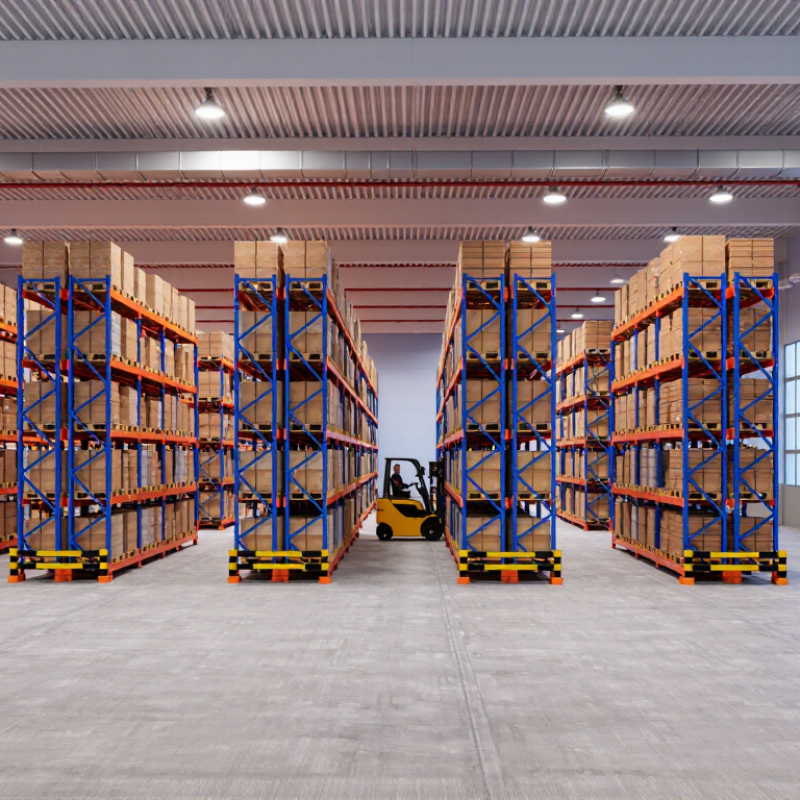
How to Choose Heavy Duty Racks for Your Warehouse?

Assess Warehouse Storage Needs and Load Requirements

Before selecting heavy duty racks, map the actual goods, not just the available floor area. Record each pallet’s maximum loaded weight, dimensions, and overhang. Include seasonal peaks and future product changes. A small mismatch matters: a pallet that sits unevenly can shift weight across a beam.

Count the loads per beam level and bay, then check the rack’s rated capacity against those figures. Do not treat a rack’s total capacity as the safe limit for every beam. The Rack Manufacturers’ Institute’s ANSI MH16.1 design standard addresses storage-rack design and load conditions; use its guidance with a qualified rack designer. Verify forklift type, aisle width, clear height, sprinkler clearance, and floor condition too. Concrete can look sound and still need review.

Plan for change. MHI’s 2024 Annual Industry Report found that 55% of surveyed supply-chain leaders planned to increase technology and innovation investment. That trend makes it sensible to leave room for different equipment or inventory patterns. Still, don’t size racks from forecasts alone. Measure today’s heaviest pallet, confirm its load distribution, and document the assumptions. Some warehouse data is messy; revisit the calculations when products or handling methods change.

Compare Heavy-Duty Rack Types and Configurations

Selective pallet racks suit warehouses that handle many product lines and need direct access to each pallet. Each bay holds separate loads, but wide aisles can reduce storage density. Check beam capacity, upright condition, and pallet dimensions before choosing a layout. Access matters.

Drive-in racks store pallets several positions deep, making them useful for large batches of similar goods. Forklifts enter the rack lanes, so operators need clear procedures and careful load placement. Push-back systems also increase density, while allowing several pallets to sit on inclined carts. They can speed up loading, though the rear pallets are less accessible. Not always a fit.

Cantilever racks support long or awkward items, such as pipes, timber, or sheet material. Adjustable arms help accommodate changing lengths, but the load must be balanced across them. Pallet flow racks use rollers to move stock toward the picking face, supporting first-in, first-out rotation. Their moving parts require inspection. A common planning mistake is choosing the densest configuration before checking order patterns, forklift turning space, and ceiling height. The best comparison starts with actual inventory and daily handling routes, not a rack’s capacity alone.

How to Choose Heavy Duty Racks for Your Warehouse? — Compare Heavy-Duty Rack Types and Configurations

Rack type Typical configuration Storage density Pallet selectivity Inventory flow Best suited for Key trade-offs
Selective pallet rack Single-deep pallet positions accessed from an aisle; commonly arranged in back-to-back rows. Low to medium; aisles between rows use floor area. High; each pallet position is directly accessible. Works with FIFO or LIFO, depending on warehouse processes. Warehouses with many SKUs, varied stock, or frequent picking and replenishment. Simple access and flexible slotting, but generally stores fewer pallets per floor area than deep-lane systems.
Double-deep pallet rack Two pallet positions deep on each side of the aisle; requires a suitable reach truck or attachment. Medium to high; fewer aisles are needed than with single-deep layouts. Medium; the rear pallet is not directly accessible until the front pallet is moved. Typically LIFO within each two-pallet-deep lane. Operations holding multiple pallets per SKU and seeking more density without a fully deep-lane system. Improves storage density, but needs compatible handling equipment and tighter inventory planning.
Drive-in / drive-through rack Forklifts enter guided lanes to store or retrieve pallets; lane depth is designed around the load and equipment. High; shared aisles and deep lanes reduce aisle space. Low; pallets within a lane are less individually accessible. Drive-in is generally LIFO. Drive-through can support FIFO when loading and unloading occur at opposite ends. Large quantities of similar products, batch storage, and operations with relatively few SKUs per lane. High space utilization, but careful forklift operation, lane management, and load compatibility are important.
Push-back rack Multiple pallets stored deep on wheeled carts or nested rails; loading pushes earlier pallets farther into the lane. High; several pallet positions share a lane and aisle. Low to medium; access is typically by lane rather than to every pallet. Usually LIFO within a lane. Several pallets per SKU where faster access than drive-in is useful and strict FIFO is not required. Can improve throughput compared with entering a drive-in lane, but has more moving components and a higher system-specific cost.
Pallet flow rack Inclined roller or wheel lanes move pallets from the loading face to the picking face. High; deep lanes make efficient use of floor area. Medium; each lane is dedicated to a SKU or product group. FIFO, with loading and retrieval on opposite sides. High-volume, date-sensitive, or batch-controlled products with predictable pallet movement. Supports orderly stock rotation, but lane design, pallet condition, and maintenance of flow components matter.
Cantilever rack Upright columns with projecting arms; arms can be configured for one-sided or two-sided storage. Medium; long items can be stored without front columns obstructing access. High for stored lengths when items are arranged by product or size. Usually managed by item location and handling sequence rather than pallet-lane FIFO or LIFO. Long or awkward loads such as pipe, timber, bar stock, panels, and furniture. Provides open-front access, but arm spacing, load overhang, and the rated capacity of each arm and column must be checked.

Selection note: Rack capacity and layout are project-specific. Confirm pallet or product dimensions, maximum unit load, load distribution, clear building height, floor condition, handling equipment, sprinkler and building-code requirements, and required inventory flow with a qualified rack designer. Never exceed posted load ratings.

Check Load Capacity, Safety Features, and Compliance

How to Choose Heavy Duty Racks for Your Warehouse?

Start with the heaviest actual pallet, not an average estimate. Check the rack’s beam, upright-frame, and bay capacities, then confirm the floor can support the combined load. Capacity labels may assume evenly distributed weight; a shifted pallet changes the picture. That detail matters.

The U.S. Bureau of Labor Statistics reported a 2022 recordable injury and illness rate of 4.8 cases per 100 full-time workers in warehousing and storage. That figure does not isolate rack failures, but it underlines why safe handling and stable storage deserve attention. Look for clear load signs, secured beams, column guards in forklift lanes, and visible inspection records. OSHA’s 29 CFR 1910.176(b) requires stored materials to be stable and secure against sliding or collapse.

Check that the rack design and installation follow applicable local requirements and recognized guidance, such as ANSI MH16.1 for industrial steel storage racks. Ask for load calculations and installation documentation, not just a catalog rating. Inspect anchors, beam locks, and uprights after impacts; small dents can be easy to dismiss. I would not assume a rack is safe because it looks straight. Have a qualified person assess damage and confirm the system suits your pallets, lift equipment, and site conditions.

Match Rack Dimensions to Layout and Handling Equipment

Choosing heavy-duty racks starts with the warehouse, not a catalog. Measure usable floor area, clear height, columns, doorways, dock paths, and overhead obstructions such as lights or sprinkler lines. Map the pallet footprint, including any overhang. Small errors matter.

Rack depth and beam length should suit both the load and the way it is placed. A pallet approached from its short side may need a different bay opening than one handled from its long side. Compare the forklift’s or reach truck’s load center and mast height with the rack plan. Confirm turning radius and aisle width using equipment specifications. A floor test can expose tight turns that drawings miss. Measure twice.

Allow practical clearance for guards, pallet placement, and routine inspection, while keeping travel routes clear. Match the top beam level to the ceiling limit and the tallest stored unit, not just the pallet. Rack capacity depends on bay configuration, beam levels, and load distribution, so have a qualified rack professional verify the proposed layout. Even a careful plan may need revision: a trial bay can reveal awkward reaches or wasted space once operators handle real loads.

How to Choose Heavy Duty Racks for Your Warehouse?

Match rack layout and aisle clearance to the handling equipment used in your warehouse.

Typical planning estimates: counterbalance forklifts often need wider aisles than reach trucks or very-narrow-aisle trucks. Confirm clearances against the equipment specifications, load dimensions, turning requirements, and site conditions before finalizing rack dimensions.

Evaluate Installation, Durability, and Long-Term Costs

Before comparing heavy duty racks, measure the space where they will actually stand. Check ceiling height, aisle width, floor condition, and the turning radius of loaded equipment. A rack that fits on a drawing may block a sprinkler line or leave too little room for safe handling. Ask for installation drawings and confirm who will inspect anchors, uprights, and beam connections after assembly. A level floor helps, but it does not replace a qualified assessment of floor capacity. Small details matter.

Durability depends on more than steel thickness. Look at the rated capacity for each beam level, the finish in damp or dusty areas, and how easily damaged parts can be replaced. If forklifts operate nearby, add suitable column protection and keep clear load labels visible. Long-term cost includes delivery, installation, inspections, repairs, and downtime—not just the purchase price. Compare those costs over the expected service life, using realistic assumptions about shifts and load changes. I would not rely on a low quote alone; missing installation work can make it misleading. And forecasts are imperfect. Leave room in the layout for future changes, but avoid paying for capacity your operation is unlikely to use.

FAQS

How should I estimate the rack capacity I need?

Start with your heaviest actual pallet, not an average. Check beam, frame, and full-bay capacities. A shifted load can change the calculation.

Does the floor need a separate capacity check?

Yes. Confirm it can support the rack and its combined stored loads. A level floor alone is not enough.

Which safety details should I look for?

Check visible load labels, secured beams, and column guards near forklift lanes. Keep inspection records easy to find. Small details matter.

How often should racks be inspected?

Inspect anchors, beam locks, and uprights regularly, especially after an impact. Even a small dent deserves attention. Looks can deceive.

What should I measure before choosing a rack?

Measure ceiling height, aisle width, and floor space. Check sprinkler clearance and the turning radius of loaded equipment. Drawings can miss things.

How can I judge rack durability?

Review capacity at each beam level, surface finish, and replacement-part availability. Consider damp or dusty conditions and nearby forklift traffic.

What costs should I compare beyond the purchase price?

Include delivery, installation, inspections, repairs, and possible downtime. A low quote may leave out important work. I might overlook something, too.

Should I buy extra capacity for future changes?

Leave some room for changing loads or layouts, but avoid paying for capacity you may never use. Forecasts are imperfect.

Conclusion

Choosing Heavy Duty Racks starts with understanding what your warehouse needs to store, including the size, weight, quantity, and movement frequency of each item. Compare rack types and configurations to find a system suited to your inventory and picking methods. Check that rated load capacities match your requirements, and look for practical safety features such as secure connections and protection against impact. Confirm that the rack dimensions fit the available space and work with your forklifts or other handling equipment.

Also consider how the racks will be installed, how durable their materials are under everyday use, and what maintenance they may require. Comparing the full long-term costs—not just the initial purchase price—can help you choose a reliable storage solution that uses space efficiently and supports safe, smooth warehouse operations.

Amelia

Amelia

Amelia is a seasoned marketing professional with a wealth of expertise in our company’s core offerings. With an unwavering passion for driving growth and innovation, she plays a pivotal role in shaping our marketing strategies and enhancing brand visibility. A key aspect of her responsibilities......