Modular Shelving has moved beyond simple storage. It now supports retail displays, warehouses, offices, libraries, and compact homes. Buyers want systems that adapt when products, rooms, or business needs change. They also expect easier transport, faster assembly, and longer service life.
Industry research supports this shift. Grand View Research’s modular furniture market analysis identifies flexibility, space efficiency, and changing workplace layouts as important demand drivers. The report also highlights growing interest in reconfigurable products across commercial and residential settings. Meanwhile, CBRE’s global workplace research shows that companies continue adjusting office footprints and shared spaces. Storage must keep pace. A fixed cabinet can become an obstacle quickly.
For international buyers, comparison requires more than attractive photographs. Shelf load ratings, frame materials, coating quality, connection methods, packaging, and replacement-part access all deserve attention. TÜV Rheinland and Intertek testing guidance also reminds purchasers to examine product safety, stability, and material performance. Regional standards may differ, so supplier documentation matters. Small details matter most.
This guide reviews ten leading Modular Shelving systems for global purchasing decisions. It considers installation time, adjustability, durability, visual design, and total ownership value. Some rankings remain subjective. No system fits every market. That is the uncomfortable part. A lightweight shelf may travel cheaply but perform poorly under heavy stock. A premium steel system may last longer but exceed a small project’s budget. These trade-offs are real. The following selection aims to make them easier to see, compare, and question.
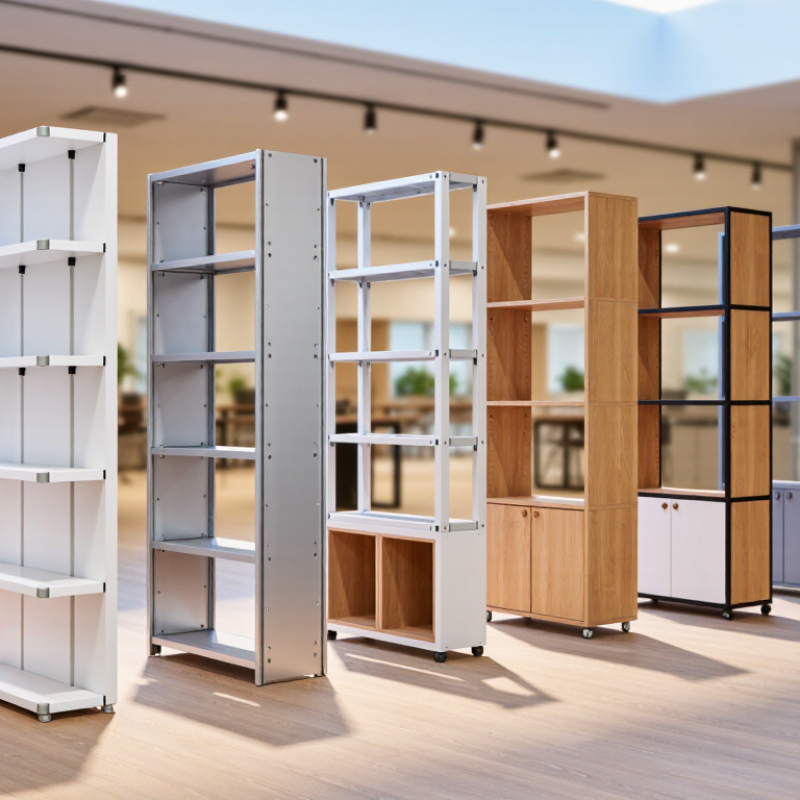
For global buyers, modular shelving means more than movable panels and adjustable brackets. ISO 7170 defines storage-unit testing around strength, durability, and stability. ANSI/BIFMA X5.9 adds performance tests for office storage units, including loaded shelves, doors, drawers, and structural connections. Together, these standards create a practical purchasing language.
A serious specification should state shelf load, test configuration, adjustment range, and anchoring method. A shelf holding 40 kilograms in a laboratory may perform differently when loads shift repeatedly. That detail matters in warehouses, libraries, and open-plan offices. Field experience also shows that thin panels can flex before visible failure. Not ideal.
Industry forecasts support this demand for adaptable furniture. Grand View Research’s 2024 modular furniture analysis projects continued market growth through 2030, with a reported compound annual growth rate near 6%. However, market estimates differ widely. Definitions often mix residential kits, office systems, and industrial storage. Buyers should question the dataset, not just repeat its headline figure.
For cross-border purchasing, request test reports that identify the exact configuration. Confirm whether the evidence covers lateral stability, repeated loading, and connection fatigue. ISO 7170 and ANSI/BIFMA X5.9 do not automatically guarantee every installation will be safe. Floors, walls, climate, and user behavior still matter. Standards guide judgment; they do not replace it.
10 Best Modular Shelving Systems for Global Buyers
Choosing modular shelving requires more than checking appearance. I compare ten common systems through tested load capacity, shelf depth, materials, and assembly effort. Boltless steel shelving often supports 150–500 kilograms per shelf, with 40–60 centimeter depths. Rivet shelving offers similar strength and usually assembles with a rubber mallet. Wire shelving is lighter, ventilated, and commonly uses 35–45 centimeter shelves. Track shelving adjusts quickly, but wall fixing must be reliable. Slotted-angle shelving is economical, though assembly takes longer.
Aluminum extrusion systems are corrosion-resistant and easy to modify, but their load ratings vary widely. Plywood cube units suit homes and offices, with roughly 15–30 kilograms per compartment. Plastic shelving resists moisture and assembles quickly, yet deeper shelves may bend under concentrated weight. Cantilever shelving handles long materials and needs careful floor anchoring. Mobile shelving saves aisle space, but loaded movement requires strong wheels and level flooring. Folding modular units are convenient for temporary use, although their joints deserve close inspection.
Tips: Place heavy cartons low. Measure real shelf depth, not advertised depth. Leave clearance for hands and doors. Confirm whether capacity applies per shelf or per bay. Ask for corrosion tests, assembly drawings, replacement parts, and packaging details. I have seen “tool-free” systems still need careful leveling. That small step affects safety. Also, published capacities may assume evenly distributed loads, which many buyers overlook. Evaluate local floor conditions, delivery damage risks, and worker access before ordering.
10 Best Modular Shelving Systems for Global Buyers
Safety should guide every modular shelving decision, not only price or appearance. EN 14749 provides useful requirements for domestic storage furniture, including stability, strength, and durability. However, its application depends on the product’s design and intended use. ASTM F2057 focuses mainly on clothing storage units and tip-over hazards. It should not be treated as a universal shelving standard. Buyers should request current test reports, product scope, load ratings, and assembly instructions from suppliers.
Anti-tip performance needs practical verification. Check whether the unit requires wall anchoring, interlocking modules, or a weighted base. Confirm that anchors match the wall material, such as concrete, brick, or drywall. A tall shelf loaded with books can create strong forward force. Place heavier items on lower levels. Inspect connectors for looseness after installation and after moving the system. Small gaps can become serious weaknesses.
Tips: Ask for test evidence, not only compliance claims. Measure the intended wall and floor conditions before ordering. Review the maximum load per shelf and for the complete unit. Keep children away during assembly and use. A simple checklist is not enough. In my experience, unclear instructions often cause avoidable instability. Buyers should also allow for real-world mistakes, uneven floors, and uneven loading. Standards improve confidence, but careful installation remains essential.
| Rank | Modular System Type | Typical Configuration | Common Materials | Typical Shelf Load* | EN 14749 Checkpoint | ASTM F2057 Checkpoint | Anti-Tip Requirements | Buyer Evidence to Request |
|---|---|---|---|---|---|---|---|---|
| 1 | Adjustable steel-post shelving | 5–7 shelves; 600–1200 mm wide; 300–450 mm deep; 1800–2400 mm high | Powder-coated steel uprights and steel or melamine shelves | 50–150 kg per shelf | Verify furniture stability, strength, and wall-fixing provisions | Generally outside scope unless designed as a clothing-storage unit | Mandatory anchoring for tall or heavily loaded units; assess loaded and partially loaded conditions | Load chart, stability test report, anchor hardware rating, installation instructions |
| 2 | Slot-and-post boltless shelving | 4–6 levels; 900–1800 mm wide; 350–600 mm deep; 1500–2400 mm high | Painted or galvanized steel frames with particleboard, MDF, or steel decks | 100–300 kg per shelf | Verify resistance to racking, overturning, and shelf disengagement | Not normally applicable to open general-purpose shelving | Use a wall, floor, or bay-to-bay restraint where the height-to-depth ratio is high | Engineering calculations, permissible bay height, connector details, anti-tip kit instructions |
| 3 | Freestanding cube modular shelving | 2–5 columns; 2–6 rows; 300–400 mm cube width; 300–400 mm depth | Melamine-faced particleboard, MDF, plywood, or laminated panels | 10–30 kg per cube | Check panel joints, connector strength, stability, and edge durability | Usually outside scope unless drawers or clothing-storage compartments are included | Secure units exceeding the supplier’s stated height or narrow-base limit; interconnect stacked modules | Panel thickness, connector test data, maximum stacking height, wall-strap specification |
| 4 | Ladder-style leaning shelving | 3–5 shelves; 600–900 mm wide; 300–450 mm deep; 1500–2000 mm high | Steel or solid-wood side rails with wood-based shelves | 8–25 kg per shelf | Pay particular attention to overturning, sliding, and attachment to the wall | Not generally applicable to open decorative shelving | Wall anchoring should be treated as essential, not optional | Wall-fixing method, maximum shelf load, rear-foot design, installation torque values |
| 5 | Wire-grid modular shelving | 4–6 adjustable tiers; 600–1200 mm wide; 350–600 mm deep; 1200–2000 mm high | Chrome-plated, epoxy-coated, or stainless-steel wire components | 45–135 kg per shelf | Verify connector locking, shelf deflection, corrosion resistance, and stability | Normally outside scope unless integrated with clothing-storage drawers | Fit leveling feet and secure tall configurations to a structural wall or adjacent frame | Uniform-load test method, connector retention test, corrosion test, anti-tip accessories |
| 6 | Track-mounted adjustable shelving | 2–4 vertical standards; 4–8 brackets; 600–1200 mm wide; 200–400 mm deep | Steel wall standards with laminated wood, steel, or glass shelves | 15–45 kg per shelf | Confirm wall-standard pull-out resistance and suitability for the supporting wall type | Generally outside scope for wall-mounted open shelving | Use structural fixings at every required mounting point; do not rely on plasterboard alone | Fixing-point spacing, substrate limitations, pull-out test data, bracket locking details |
| 7 | Modular garment-storage system | 2–4 bays; 600–1000 mm per bay; 450–600 mm deep; 1800–2400 mm high | Steel or wood-based panels with hanging rails, shelves, and optional drawers | 15–40 kg per shelf; 25–60 kg per hanging rail | Directly assess applicable domestic-storage furniture stability and strength requirements | Potentially applicable when the unit is a clothing-storage unit with drawers or doors; confirm scope and edition | Install supplied anti-tip restraint; use drawer interlocks where specified | Scope statement, drawer interlock design, loaded-unit test report, anchoring template |
| 8 | Glass-and-metal display shelving | 3–6 shelves; 600–1000 mm wide; 300–450 mm deep; 1500–2200 mm high | Tempered safety glass, aluminum, or powder-coated steel | 8–25 kg per shelf | Verify stability, glass retention, edge protection, and shelf-support strength | Normally outside scope unless configured as a clothing-storage unit | Anchor tall display units and prevent shelf disengagement under accidental impact | Glass classification, impact or fragmentation evidence, shelf-retainer details, anchor rating |
| 9 | Mobile modular shelving cart | 3–5 shelves; 700–1200 mm wide; 350–600 mm deep; 900–1800 mm high | Steel frame, wood-based or steel shelves, locking casters | 20–80 kg per shelf | Assess stability with casters locked and unlocked, including uneven-load conditions | Usually outside scope unless it incorporates clothing-storage drawers | Use locking casters, low center of gravity, positive shelf locks, and a stated maximum height | Caster load rating, brake test, overturning test, maximum moving load, wheel-lock instructions |
| 10 | Stackable modular storage cabinets | 1–3 stackable modules; 600–900 mm wide; 350–500 mm deep; 700–2100 mm total high | Powder-coated steel, engineered wood, laminate, or mixed construction | 20–60 kg per internal shelf | Check module-to-module locking, door loading, and resistance to overturning | Potentially applicable if intended for clothing storage and equipped with drawers or doors | Use positive stack connectors and wall anchoring; prevent simultaneous opening of unstable drawers | Stacking connector test, drawer interlock evidence, anti-tip restraint, maximum stack height |
| *Important: Shelf-load figures are typical planning ranges for comparable modular constructions, not certified capacities. Actual capacity depends on span, shelf material, support spacing, load distribution, fixing method, and installation. EN 14749 should be applied only where the product falls within its stated scope. ASTM F2057 addresses clothing-storage units and should not be treated as a general shelving standard. For every configuration, request a product-specific test report, installation instructions, anchoring hardware specification, and the applicable standard edition before purchase. | ||||||||
Choosing among the 10 best modular shelving systems requires more than comparing retail prices. Flat-pack volume affects freight, storage, and import fees. Measure each carton in cubic meters, then check dimensional weight with the carrier. A compact frame can still ship inefficiently when panels use oversized packaging. UNCTAD’s Review of Maritime Transport 2024 reported global maritime trade growth of about 2.4% in 2023, but freight conditions remained uneven across routes. That makes landed-cost testing essential.
Ask suppliers to declare the correct HS 9403 classification for furniture and shelving products. However, HS codes can vary by material, function, and national customs interpretation. Confirm the local tariff before payment. The World Bank’s Logistics Performance Index 2023 evaluates customs, infrastructure, shipment quality, and delivery reliability on a 1–5 scale. Use that framework when comparing destination countries, not just quoted shipping prices. A lower freight quote may hide slower clearance or poor last-mile handling.
Tips: Request carton dimensions, gross weight, pallet limits, and a sample commercial invoice. Record warranty length, claim-response time, replacement-part coverage, and exclusions. Warranty data deserves skepticism. A five-year promise means little without published claim procedures or regional service access. Ask for anonymized claim rates by product category. If the supplier cannot provide them, mark the risk clearly. I would also test one shipment before ordering at scale. It costs more initially, but prevents an expensive assumption.
For global buyers, the best modular shelving systems balance four factors: price, scalability, durability, and support. The lowest-cost options often use lighter steel and fewer accessories. They suit small inventories but may flex under dense loads. Mid-priced systems usually offer stronger frames, adjustable levels, and easier expansion. Premium systems rank highest for corrosion resistance, load stability, and long-term replacement support. However, the most expensive choice is not always the best value.
My ranking places budget systems first for simple storage, flexible boltless systems second for growing warehouses, and reinforced modular units third for heavy industrial use. Systems with clear load charts and tested connectors deserve higher scores. Local spare-part availability also matters. A damaged shelf should not stop an entire operation. Buyers should check delivery costs, assembly instructions, warranty limits, and regional compliance documents. One weakness remains: published capacity can differ from real performance on uneven floors.
Tips: Measure doorways and ceiling height before ordering. Request a sample connector if possible. Confirm shelf loads with your actual cartons, not empty boxes. Choose replaceable parts over decorative finishes. Keep a small reserve of beams and clips.
Support quality can separate similar products. Responsive technical teams should explain anchoring, expansion, and safe loading in plain language. Multilingual manuals help international teams, but translated documents can contain mistakes. Ask specific questions before payment. A reliable supplier should answer with drawings, dimensions, and realistic lead times. This process takes longer, yet it often prevents expensive installation changes later.
Comparative ranking by price competitiveness, scalability, durability, and buyer support
Scores use a 1–10 benchmark based on commonly published modular-shelving characteristics, including relative purchase cost, expandability, material and load performance, warranty clarity, documentation, and international purchasing support. Higher scores indicate stronger overall performance; price competitiveness measures better value at the same score level.
Steel and rivet systems often support 150–500 kilograms per shelf. Capacity usually assumes evenly distributed weight. That assumption is easy to miss. Place heavy cartons on lower levels. Always confirm shelf capacity and full-bay capacity separately.
Many steel shelves measure 40–60 centimeters deep. Wire shelves commonly measure 35–45 centimeters. Home cube units are often shallower. Measure usable depth, not advertised depth. Leave space for hands, doors, and safe access.
Aluminum resists corrosion and allows frequent modifications. Plastic handles moisture well but may bend under concentrated weight. Plywood cubes suit offices, bedrooms, and light storage. Wire shelves improve airflow around stored items. Material alone does not prove strength.
Rivet shelving often needs only a rubber mallet. Boltless systems reduce hardware and assembly time. Slotted-angle systems cost less but require more fitting. Some “tool-free” units still need careful leveling. That detail matters.
Secure tall units according to the wall material. Concrete, brick, and drywall need different anchors. Use interlocking modules or weighted bases when suitable. Inspect connectors after assembly and relocation. Small gaps can become serious weaknesses.
Request current test reports, load ratings, and clear assembly instructions. Check whether the evidence matches domestic, office, or industrial use. Ask about wall anchoring requirements and uneven-floor limits. Standards help, but installation still controls real stability. I would not trust a certificate alone.
Measure every carton’s length, width, height, and gross weight. Carriers may charge by dimensional weight rather than actual weight. Oversized panels can increase freight costs unexpectedly. Test one shipment before placing a large order. It feels slower.
Confirm warranty length, exclusions, replacement parts, and response times. Ask whether regional service is available. A long promise means little without claim procedures. Request anonymized claim data when possible. If unavailable, record the uncertainty clearly.
This guide presents a practical framework for selecting Modular Shelving systems for international purchasing. It first defines modular construction through the principles of ISO 7170 and ANSI/BIFMA X5.9, then compares ten system types by load capacity, shelf depth, materials, adjustability, and assembly requirements. The analysis focuses on how each design supports different storage needs while balancing flexibility, strength, and installation effort.
Safety and purchasing considerations are also examined in detail. The guide reviews EN 14749, ASTM F2057, and anti-tip criteria, including stability, anchoring, and responsible use guidance. It evaluates global shipping factors such as flat-pack volume, HS 9403 classification, warranty coverage, replacement parts, and buyer support. The final ranking weighs price, scalability, durability, shipping practicality, and long-term service value, helping buyers identify systems that offer dependable performance and easier international procurement without relying on brand names.

EcosystemRack